Ege
Kalay
I build digital twins, each one made for the place it shows.
I take messy live data and make it something people understand at a glance. The engine underneath stays the same. Only the objects and the words change with the place.
One thing, and what it's doing right now.
A die-casting cell, read the way its controller really reports. Each shot is split into its phases, so the lost seconds show up where they happen.
Change the place. The engine stays.
On a hospital floor the thing is a bed. Stopped becomes empty but still on the record, and what it costs is a patient waiting downstairs.
New objects, new words.
On a ridge it's twelve turbines and a city below. The question is how much of the coming days' demand the wind will cover, and when it's calm enough to send a crew up.
Down to a single axle.
On a suburban train it's every axle's speed as the set brakes, and the one axle that locks at every stop.
Or a whole city's water.
In a water network the thing is a district, and unusual means drawing more at night than it normally does. The twin narrows the loss down to one area.
Your place is next.
If it produces data, it can have a twin built for it, with your objects and in your words.
Ten places, all working demos.
Each one is a demo I built, and each film is scripted inside the demo's own scene. Open one to watch the film or to move through the live demo yourself.
-
Hospital
Emergency, wards, intensive care and theatres on one floor. It shows beds that are empty but still on the record, and pumps nobody can find.
-
Wind farm
Each turbine's output against the city's demand three days ahead, so maintenance lands in a calm window.
-
Real public dataAnkara's water
Dam levels, inflow and supply from the figures the city publishes, with what-if scenarios on top.
-
MRI suite
The day's exams against the schedule, with the delays traced back to the scanner's cooling.
-
Resort hotel
Guests moving through reception, the buffet and the pool. You can try a third desk before the busy day comes.
-
Water network
A district's night flow against its normal, with the loss traced to one street.
-
Suburban train
Every axle's speed as the train brakes, which finds the one axle that locks at every stop.
-
Train depot
Wheel measurements, inspection and the wheel lathe through the night. It shows which set will miss the morning service, hours ahead.
-
Weaving hall
Efficiency by zone and stops split by cause, with the loss counted in metres of fabric.
-
Die-casting cell
One casting cycle split into its phases, so you can see where the seconds go and what the die data says about them.
-
Yours next
Your place
A building, a fleet, a network or something no one has twinned yet. Tell me about it.
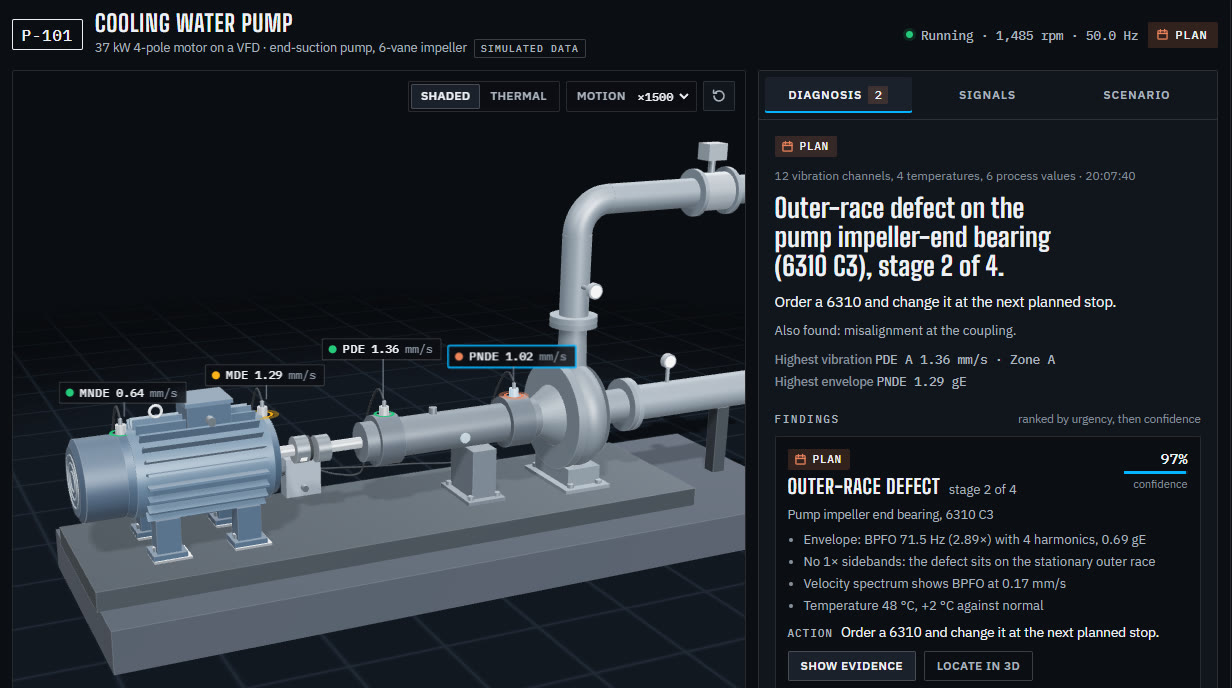
A cooling water pump that says what's wrong with it.
A pump's twin with a diagnosis engine. It reads vibration, temperature and process data from four bearings, names the fault and how far along it is, and says what to do about it. You can inject a fault yourself and watch the finding change.
Open the live demoThe data in every demo is simulated, apart from Ankara's water, which uses published figures. The demos are hosted on ono.com.tr.
Four parts, made to fit your place.
The 3D model is the part everyone notices first, and the smallest one. A twin people trust is mostly the three layers underneath it.
-
1
A place
A 3D model of the space puts each thing where it really is, so people find it without knowing its name or code.
Your floor, ward or depot built from your layout, with objects that look like your machines, beds or turbines.
-
2
Meaning
Raw values become plain answers. What state something is in, for how long, and whether that's unusual for it.
Your states, your reasons and your units, named the way your people already say them.
-
3
Memory
A reading only means something next to what that thing normally does, so the twin keeps each one's history.
Normal is learned from your own past, not from a generic benchmark.
-
4
The data
Read the way each source really behaves. Some report every second, some only on change, some go quiet without saying so.
A small collector next to the systems you already have, so nothing gets replaced to make the twin work.
Drawn as a section, from what people see down to the data it stands on.
The work behind it.
The platform the twins run on, the simulator that plans a line before it exists, and everything else.
OnoTwin Studio, where the twins run.
The main piece of work. I designed and built it at ONO, and today it runs in factories, where the things are machines and the layers are electricity and water. Almost nothing in it is fixed. What a thing is, what a layer measures, what a label shows and who gets which alert are all set by the people using it.
1Collector
Sits next to the source systems and reads them the way they actually behave, with change events, counters that only go up, units that don't agree and sources that go quiet.
2Server
Keeps the history and turns readings into plain answers. It writes a report every morning, week and month that tells managers what went wrong, when, and what it cost.
3App
Places each thing in a 3D model of its space with its state on it, spreads a measurement over the area it really covers and replays any past moment. A shift can be read as a few sentences instead of a table.
Built around it, so it's safe to run
- Access control at the database level
- Roles each company defines for itself
- A threat model, kept current
- ISO 27001 and ISO 9001 documentation
- A desktop app that ships continuously
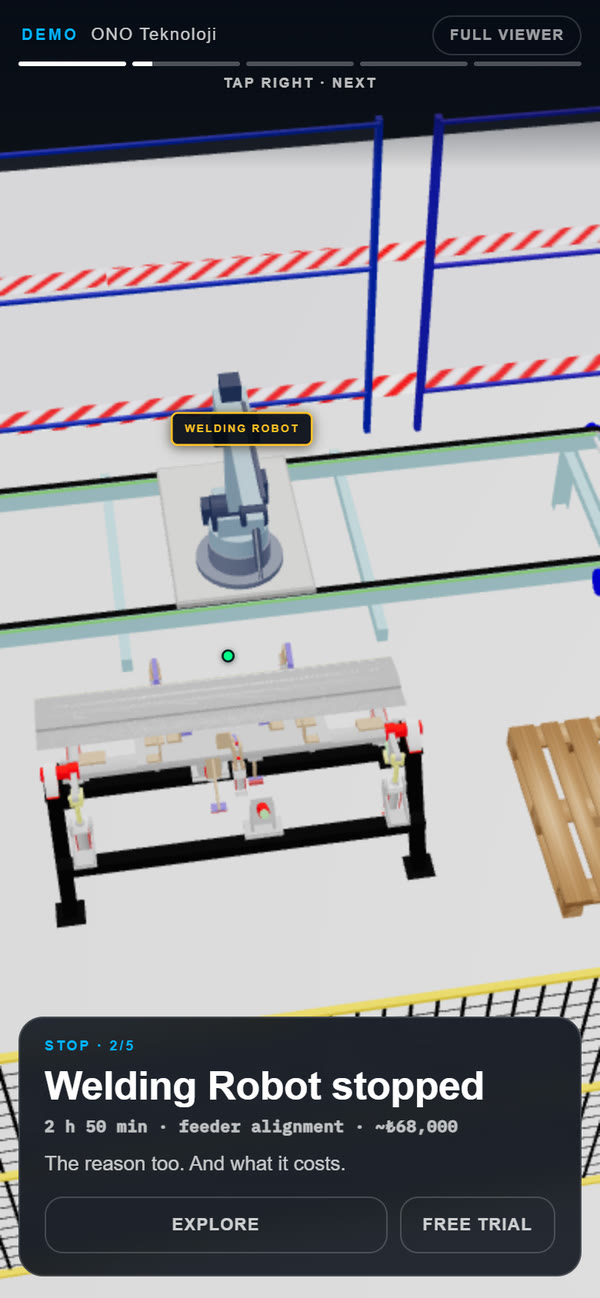
- An object library whose models are generated from code, down to a welding robot that moves on every counted cycle
On a phone, the demo tells a story
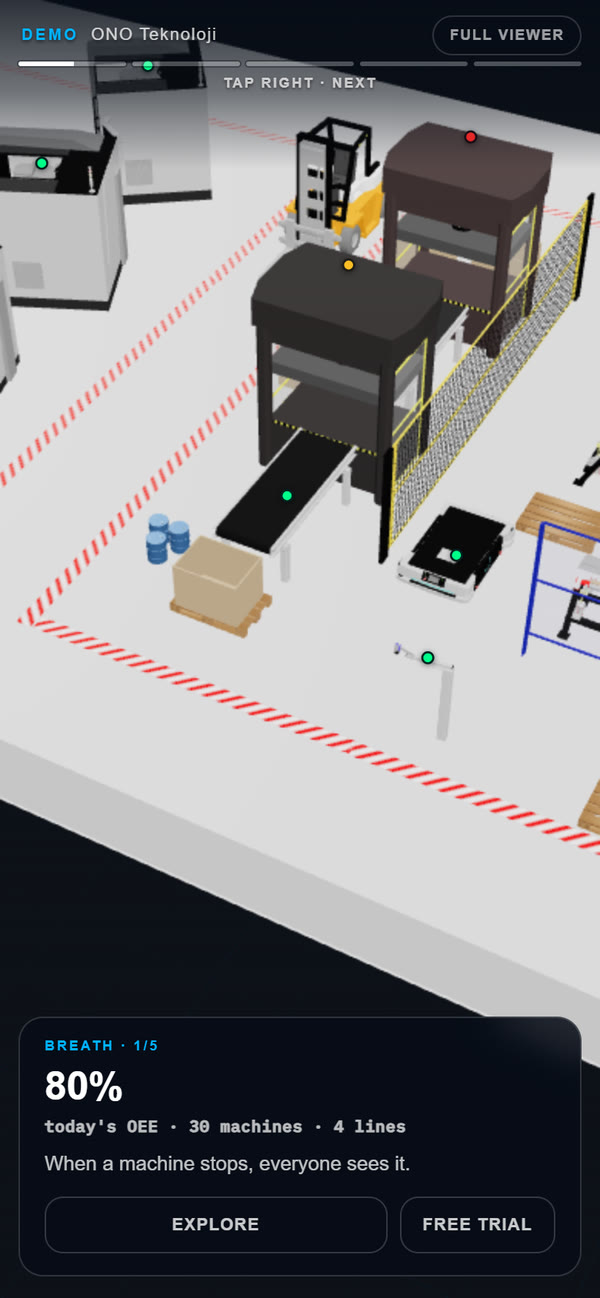
Phones don't get the viewer shrunk down. They get a page of their own, a short story in five beats over the live scene. The day's OEE, the worst stop and what it cost, a walk past the machines, the day's loss, then an invitation to explore. Every number comes from the same simulated day the full demo shows.
Open demo.ono.com.tr/studio on a phone to see it.
ONO SIM, for the questions before a line is built.
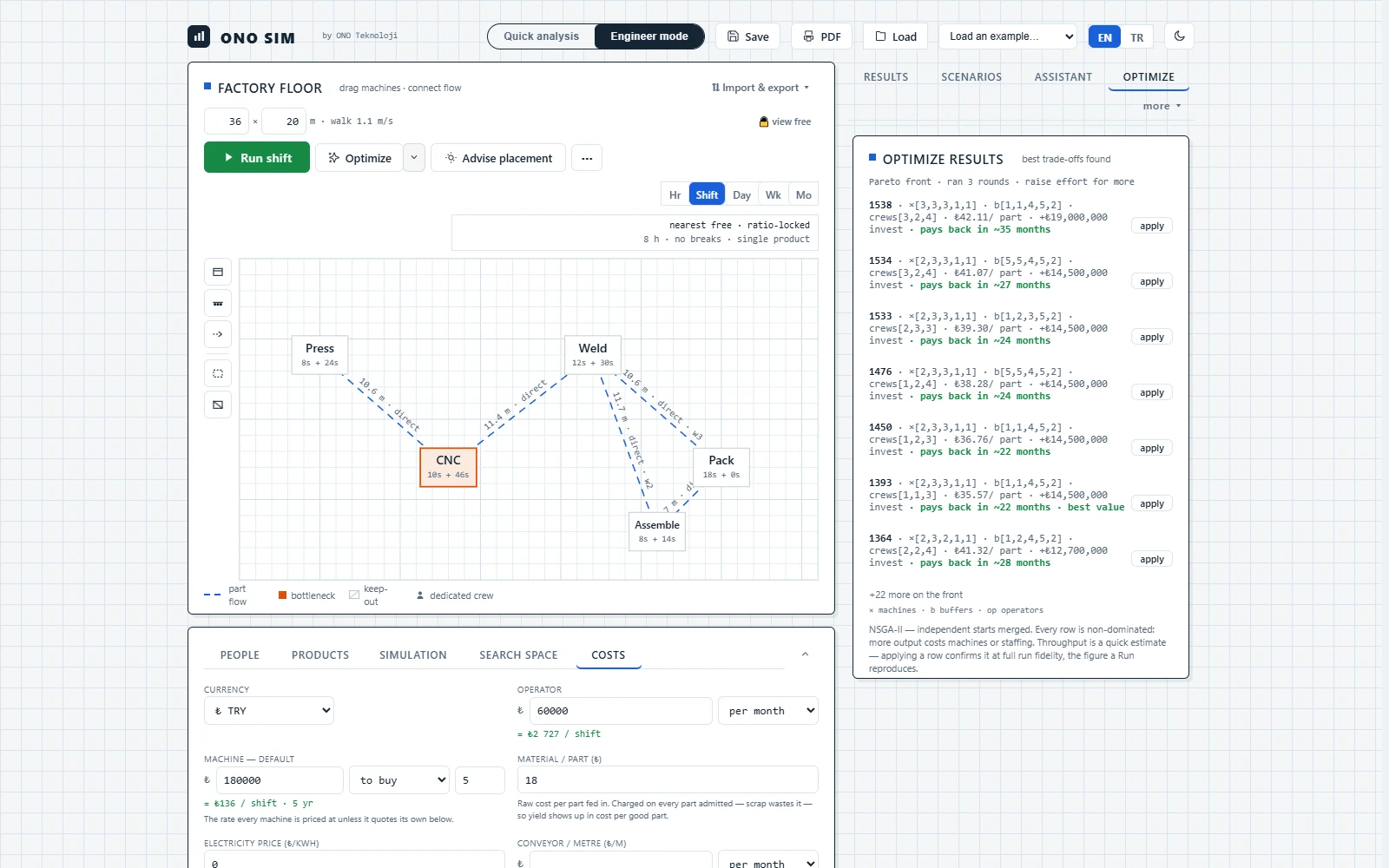
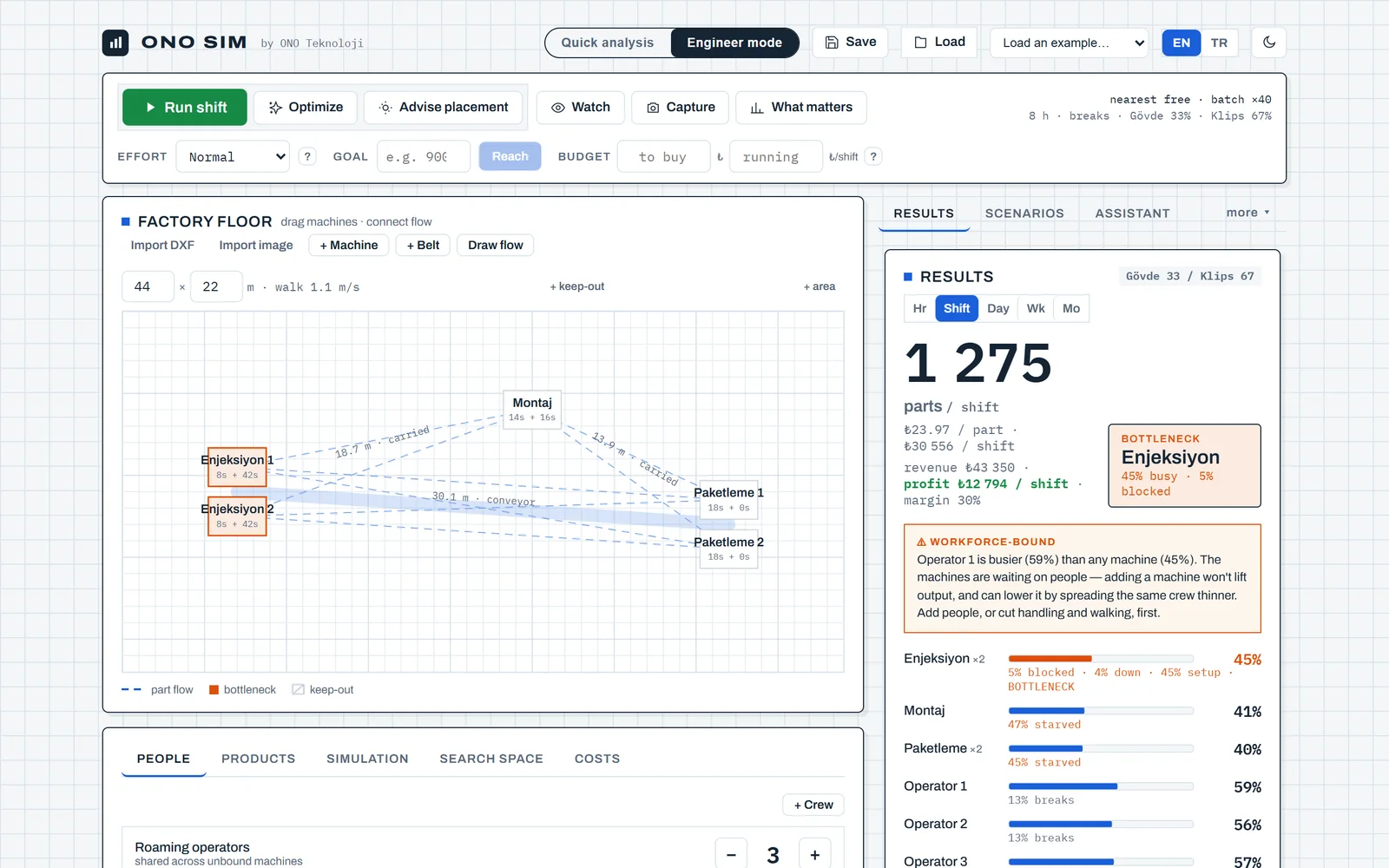
A production line simulator and optimizer I built at ONO. You draw the floor, place machines, belts and people, and it runs the shift. The engine models what lines really do, with scrap, assemblies that wait for every part, cycle times with long tails, breakdowns that wait for a free technician and raw stock that runs out.
- 1Is there a better spot for my machines in the space I already have?
- 2Can I match my line with less, or is a robot better than two more operators?
- 3What will it take to make a given number of parts in one shift?
- 4What can I build for this budget?
Every suggestion comes with what it costs and how long it takes to pay back. It only ever compares real options, so nothing moves between machines for free.
Into Visual Components
An add-on hands the planned layout to Visual Components 5. Its Python API has no public documentation, so I mapped it by hand. Once the line runs, its twin is built from the same layout.
Hat Ustası
The same optimizer as a puzzle game for phones, in twelve levels. The star targets on each level are what the optimizer itself reached, not guesses.
Try it
The live demo runs in the browser, in English and Turkish, at sim.ono.com.tr.
| Item | Work | What it was | Built with |
|---|---|---|---|
| 01 | Unity twins and VR inspectionONO Technology | Interactive 3D views of live factory data for manufacturing clients, multiplayer VR inspection tools, and an assistant that answers routine data questions for people who don't write queries. | Unity, C#, MQTT, OPC UA, Photon Fusion, Azure OpenAI |
| 02 | ono.com.trONO Technology | The company website in Turkish and English, with the 3D demos on this page built on one shared kit. Every film is scripted inside its demo and rendered frame by frame in a headless browser, so a change of wording is a re-render, not a re-shoot. | Astro, Three.js, Playwright, ffmpeg |
| 03 | Internal toolsONO Technology | A CRM for the team, with clients, contacts, follow-ups, documents and offers in one place. And a separate admin site for running every customer's Studio, built apart from the app so the admin pages never ship inside it. | React, Vite, Supabase, Cloudflare Pages |
| 04 | Corporate learning platform | A Moodle deployment for a 130-user manufacturer, from the bare server up. Sign-in through the client's own system, videos that can't be skipped, reports by department and the client's own branding. | Moodle, Nginx, PHP, PostgreSQL, Redis, Cloudflare R2 |
| 05 | Power BI portal | An embedded reporting portal for a manufacturer's operations team, covering report delivery, the licence setup and the data sources behind it. | Power BI Embedded, Azure |
| 06 | Vigla HomePersonal project | A smart home dashboard on a Raspberry Pi 5, with live sensor control, a floor plan editor, a weather page and an app launcher, all built from scratch. | Node.js, WebSocket, SQLite, Zigbee2MQTT |
| 07 | Two PC gamesSolo, as Aegean Games | Nefarium, an action RPG dungeon crawler with randomly generated floors, made for Steam, and Arena of Death, a rogue-like that hasn't been released. Design, code, art, testing and marketing, all done alone. | Unity, C#, Steamworks |
Background.
I started at ONO Technology as an intern in 2019 and went on to lead development of its visualisation tools and, from 2026, OnoTwin Studio.
Between 2021 and 2023 I made games full time, which taught me more about finishing a whole product than anything else has.
Based in Turkey. Bilkent University, Information Systems.
| Rev | Role | Where | Dates |
|---|---|---|---|
| D | Lead Software Developer | ONO Technology. OnoTwin Studio from 2026 | 2023–now |
| C | Independent game developer | Self-employed | 2021–2023 |
| B | Intern | ONO Technology | 2019 |
| A | B.Sc. Information Systems | Bilkent University | 2016–2021 |
Tell me about your place.
A floor, a building, a network or something stranger. If it produces data, it can have a twin of its own. I'm open to twin projects and to roles where this kind of work matters.